the Gentle House of Stapleton
HomeFamily ListDatabaseSurname IndexIndex of IndividualsIndex of Noble HousesFamous and Infamous People
(Emperor of All Russia) Charles Peter SCHLESWIG-HOLSTEIN-GOTTORP-ROMANOV #65811
21 FEB 1727/28 - 17 JUL 1762
Personal Information
- TITLE: Emperor of All Russia
- BIRTH: 21 FEB 1727/28, Kiel, Kiel, Schleswig-Holstein, Germany
- DEATH: 17 JUL 1762, Ropsha, Leningrad, Russia
Notes
Peter III Fyodorovich was Emperor of Russia from 5 January 1762 until 9 July of the same year, when he was overthrown by his wife, Catherine II (the Great). He was born in the German city of Kiel as Charles Peter Ulrich of Schleswig-Holstein-Gottorp, the grandson of Peter the Great and great-grandson of Charles XI of Sweden.
After a 186-day reign, Peter III was overthrown in a palace coup d'état orchestrated by his wife, and soon died under unclear circumstances. The official cause proposed by Catherine's new government was that he died due to hemorrhoids. This explanation was met with skepticism, both in Russia and abroad, with notable critics such as Voltaire and d'Alembert expressing doubt about the plausibility of death from such a condition. The personality and activities of Peter III were long disregarded by historians and his figure was seen as purely negative, but since the 1990s, after the dissolution of the Soviet Union, more attention has been directed at the decrees he signed. His most notable reforms were the abolition of the secret police, exemption of nobles from compulsory military service, confiscation of church lands, and equalisation of all religions. He also put an end to the persecution of the Old Believers and made the killing of serfs by landowners punishable by exile. Although he is mostly criticised for undoing Russian gains in the Seven Years' War by forming an alliance with Prussia, Catherine continued it and many of his other policies.
After Peter III's death, many impostors thrived, pretending to be him, the most famous of whom were Yemelyan Pugachev and the "Montenegerin Tsar Peter III" (Stephan the Little).
Early life
Peter was born on 21 February 1728 in Kiel in the duchy of Holstein-Gottorp. His parents were Charles Frederick, Duke of Holstein-Gottorp, and Grand Duchess Anna Petrovna of Russia. Charles Frederick was a grandson of Charles XI of Sweden, and Anna was a daughter of the Russian monarchs Peter the Great and Catherine I. Peter's twenty-year-old mother died just a few weeks after his birth. In 1739, Peter's father also died, and the orphaned boy became Duke of Holstein-Gottorp as Charles Peter Ulrich at the age of 11.Two years later, Peter's maternal aunt Elizabeth became Empress of Russia. As she had no children of her own, she brought Peter from Germany to Russia and proclaimed him her heir presumptive in the autumn of 1742. Previously in 1742, the 14-year-old Peter was proclaimed Grand Duke of Finland during the Russo-Swedish War (1741-1743), when Russian troops held Finland. This proclamation was based on his succession rights to territories held by his childless great-uncle, the late Charles XII of Sweden, who also had been Grand Duke of Finland. About the same time, in October 1742, he was chosen by the Swedish parliament to become heir presumptive to the Swedish throne. However, the Swedish parliament was unaware of the fact that he had also been proclaimed heir presumptive to the throne of Russia, and when their envoy arrived in Saint Petersburg in November, it was too late. Also in November, Peter converted to Eastern Orthodoxy under the name of Pyotr Feodorovich, and was created Grand Duke of Russia. The words "Grandson of Peter the Great" were made an obligatory part of his official title, underscoring his dynastic claim to the Russian throne, and it was made a criminal offence to omit them.
Empress Elizabeth arranged for Peter to marry his second cousin, Sophia Augusta Frederica (later Catherine the Great), daughter of Christian August, Prince of Anhalt-Zerbst, and Princess Joanna Elisabeth of Holstein-Gottorp. Sophia formally converted to Russian Orthodoxy and took the name Ekaterina Alexeievna (i.e., Catherine). They married on 21 August 1745. The marriage was not a happy one but produced one son, the future Emperor Paul I, and one daughter, Anna Petrovna (9 December, 1757 - 8 March, 1759). Catherine later claimed in her private writings that Paul was not fathered by Peter; that, in fact, they had never consummated the marriage. During the sixteen years of their residence in Oranienbaum, Catherine took numerous lovers, while her husband did the same in the beginning.
Character
The classical view of Peter's character is mainly drawn out of the memoirs of his wife and successor. She described him as an "idiot" and as a "drunkard from Holstein", also describing her marriage with him with "there is nothing worse than having a child-husband"; even Peter's idol, Frederick the Great mentioned him by saying "he allowed himself to be dethroned like a child sent off to bed".This portrait of Peter can be found in most history books, including the 1911 Encyclopædia Britannica:
Nature had made him mean, the smallpox had made him hideous, and his degraded habits made him loathsome. And Peter had all the sentiments of the worst kind of a small German prince of the time. He had the conviction that his princeship entitled him to disregard decency and the feelings of others. He planned brutal practical jokes, in which blows had always a share. His most manly taste did not rise above the kind of military interest which has been defined as "corporal's mania," the passion for uniforms, pipeclay, buttons, the "tricks of parade and the froth of discipline." He detested the Russians, and surrounded himself with Holsteiners.
There have been many attempts to revise the traditional characterization of Peter and his policies. The Russian historian A. S. Mylnikov views Peter III very differently:Many contradictory qualities existed in him: keen observation, zeal and sharp wit in his arguments and actions, incaution and lack of perspicuity in conversation, frankness, goodness, sarcasm, a hot temper, and wrathfulness.
The German historian Elena Palmer goes even further, portraying Peter III as a cultured, open-minded emperor who tried to introduce various courageous, even democratic reforms in 18th-century Russia. A monument for Peter III stands in Kiel, the city of his birth.Overthrow and death
Tsar Peter III was seen as a largely ineffective and unpopular ruler. He was a German-born prince of Prussia, and his loyalty to his native land over his inherited one earned him the ire of his people and his army. Peter had returned Russia's conquered territories back to Prussia and withdrawn his forces from the Seven Years' War, rendering all of Russia's recent victories, and its sacrifices, pointless.Many in the Russian army, as well as Russian citizens and Empress Catherine herself, feared that if Peter continued his concessions to Prussia it would lead to a nationwide uprising and threaten the stability of Russia. In the spring of 1762, conspiring with her lover Grigory Orlov and others in the court and military, Catherine began plotting to overthrow her husband.
At dawn on June 28, 1762, Catherine marched with a procession of civilian and military supporters to the Winter Palace, where she was proclaimed heir to the Russian throne by the archbishop of Novgorod. Peter tried to escape by taking a boat to the military base of Kronstadt on Kotlin Island, hoping that the fleet remained loyal to him. However, the fleet's cannons opened fire on Peter's boat with two or three shots, and he was repulsed back to the shore, with the commandant declaring that he was no longer recognized as emperor and that Russia was ruled by Empress Catherine. The people of St. Petersburg, drawn to the shore by the loud echoes of cannons, also armed themselves with sticks and stones to prevent him from returning to the capital city. Twenty four hours later, after learning that the senate, army, and fleet had sworn allegiance to Catherine, with the aid of two guards whom Peter had planned to discipline, he was arrested and forced to abdicate on 9 July 1762.
Shortly thereafter, he was transported to Ropsha, where he later died. Much mystery surrounds his death. The official cause, after an autopsy, was a severe attack of hemorrhoidal colic and an apoplectic stroke, while others say he was assassinated. Other accounts state that after a midday meal, Peter's captors tried to suffocate him by using a mattress but he managed to escape. This then led his captors to strangle him to death with a scarf. He was buried on 3 August 1762 [O.S. 23 July] in the Alexander Nevsky Monastery, Saint Petersburg.
Legacy
After his death, four pretenders to the throne, insisting that they were Peter (five if Šcepan Mali of Montenegro is included) came forth, supported by revolts among the people, who believed in a rumor that Peter had not died but had been secretly imprisoned by Catherine. The most famous was the Cossack Yemelyan Pugachev, who led what came to be known as Pugachev's Rebellion in 1774, which was ultimately crushed by Catherine's forces. In addition, Kondratii Selivanov, who led a castrating sect known as the Skoptsy, claimed to be both Jesus and Peter III.In December 1796, after succeeding Catherine, Peter's son, Emperor Paul I, who disliked his mother's behavior, arranged for Peter's remains to be exhumed and reburied with full honors in the Peter and Paul Cathedral, where other tsars (Russian emperors) were buried.
Lore
The legend of Peter is still talked about, especially in the town where he lived most of his life, formerly Oranienbaum, later Lomonosov, situated on the southern coast of the Gulf of Finland, 40 km west of St. Petersburg. Peter's palace is the only one of the famous palaces in the St. Petersburg area that was not captured by the Germans during the Second World War. During the war, the building was a school and people say the ghost of Peter protected the children of Oranienbaum from getting hurt by bombs. Furthermore, it was near this town that the siege of Leningrad ended in January 1944. People say that Peter, after his death, stopped Hitler's army near Leningrad, just as the living Peter had ordered the Russian army to stop, just as it was about to capture Konigsberg.Parents
Family 1 :
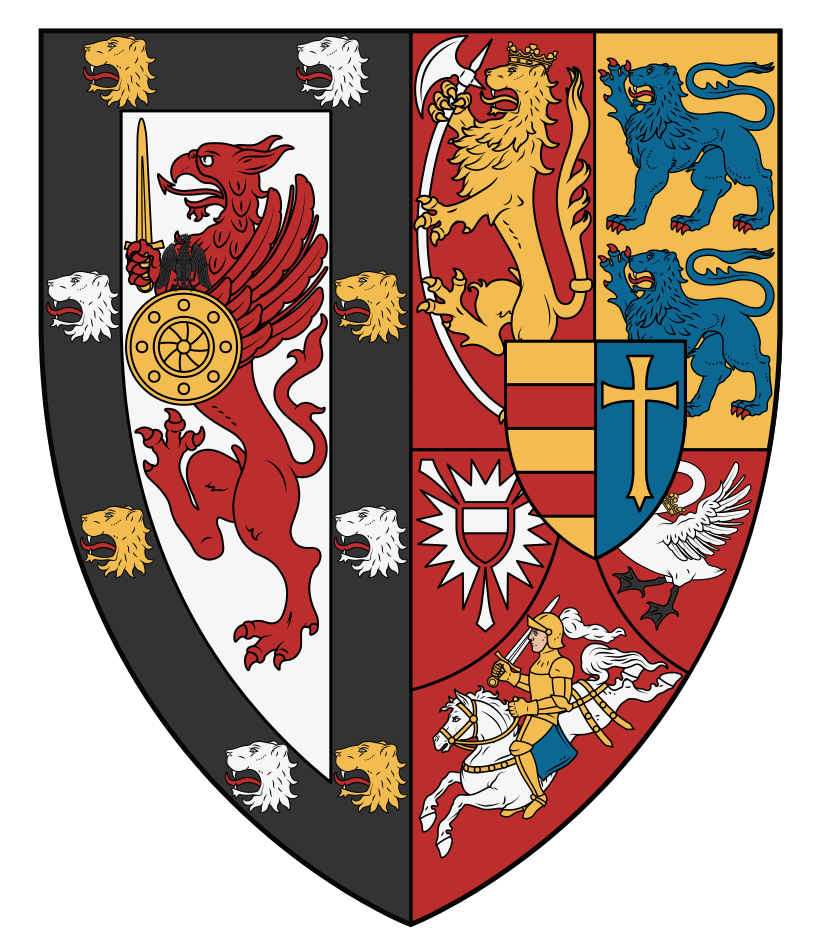

                                                                                            _Christian Albert SCHLESWIG-HOLSTEIN-GOTTORP _+
                                                                                           | (1640 - 1694)
                                                 _Frederick IV SCHLESWIG-HOLSTEIN-GOTTORP _|
                                                | (1671 - 1702)                            |
                                                |                                          |_Frederica Amalia of OLDENBURG _______________+
                                                |                                            (1649 - 1704)
 _Charles Frederick SCHLESWIG-HOLSTEIN-GOTTORP _|
| (1700 - 1739)                                 |
|                                               |                                           _Charles XI PALATINATE-ZWEIBRÜCKEN __________+
|                                               |                                          | (1655 - 1697) m 1680
|                                               |_Hedvig Sofia of PALATINATE-ZWEIBRÜCKEN _|
|                                                 (1681 - 1708)                            |
|                                                                                          |_Ulrika Eleonora of OLDENBURG ________________+
|                                                                                            (1656 - 1693) m 1680
|
|--Charles Peter SCHLESWIG-HOLSTEIN-GOTTORP-ROMANOV
|  (1727 - 1762)
|                                                                                           _Aleksei I Mikhailovich ROMANOV ______________+
|                                                                                          | (1628 - 1675)
|                                                _Peter I Alexeyevich ROMANOV _____________|
|                                               | (1672 - 1724)                            |
|                                               |                                          |_Nataliya Kyrillovna NARYSHKINA ______________
|                                               |                                            (1651 - 1693)
|_Anna Petrovna of ROMANOV _____________________|
  (1707 - 1727)                                 |
                                                |                                           ______________________________________________
                                                |                                          |
                                                |_Marta Samuilovna SKAVRONSKAYA ___________|
                                                  (1684 - 1727)                            |
                                                                                           |______________________________________________