A Family Genealogy of
the Gentle House of Stapleton
the Gentle House of Stapleton
HomeFamily ListDatabaseSurname IndexIndex of IndividualsIndex of Noble HousesFamous and Infamous People
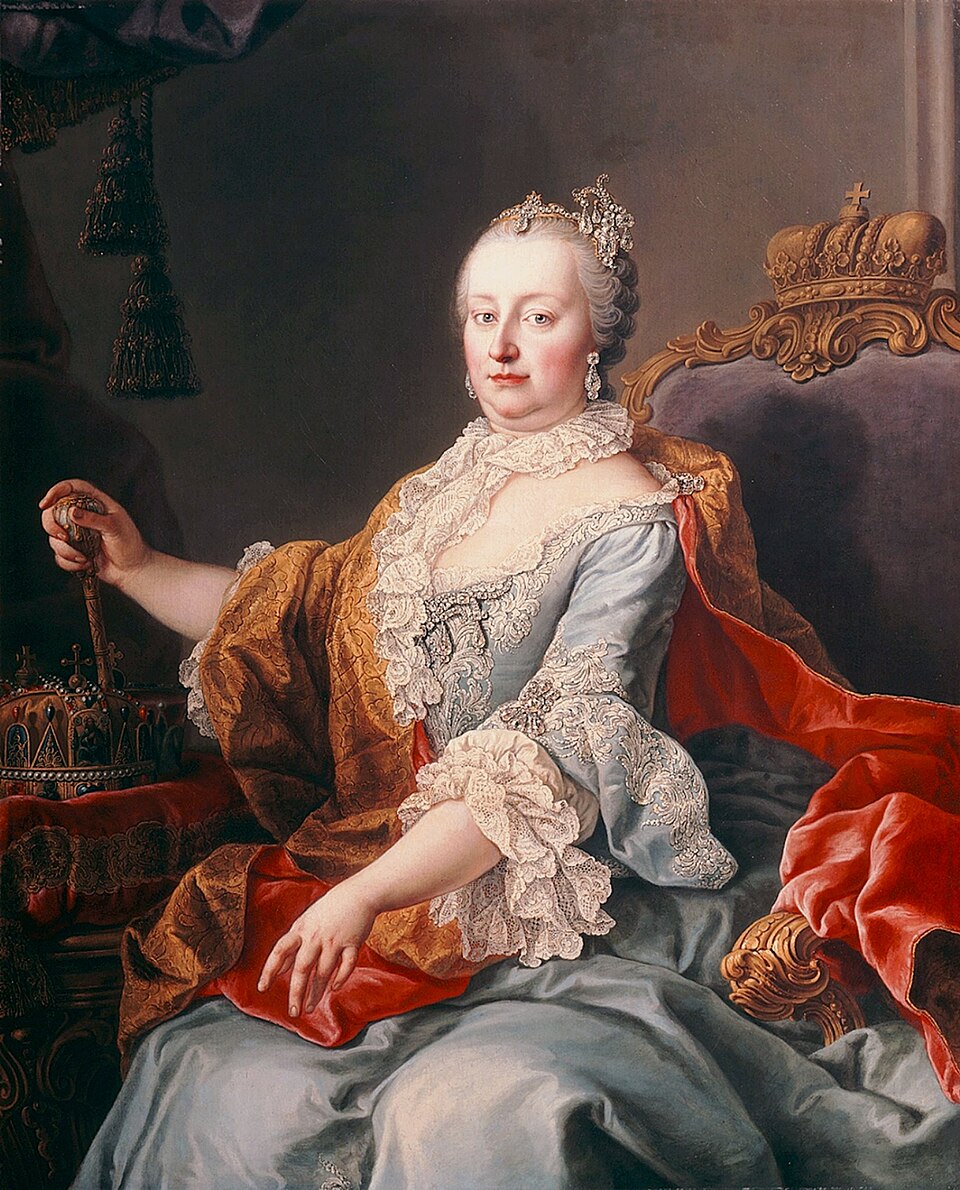
(Holy Roman Empress, Queen of Germany, Archduchess of Austria, Queen of Hungary and Croatia, Queen of Bohemia) Maria Theresa of HABSBURG #64156
13 MAY 1717 - 29 NOV 1780
AKA: Maria Theresa
Personal Information
- TITLE: Holy Roman Empress, Queen of Germany, Archduchess of Austria, Queen of Hungary and Croatia, Queen of Bohemia
- BIRTH: 13 MAY 1717, Wien, Wien, Austria
- DEATH: 29 NOV 1780, Wien, Wien, Austria
Notes
Co-Founder of the House of Habsburg-Lorraine
Maria Theresa (Maria Theresia Walburga Amalia Christina) was the ruler of the Habsburg monarchy from 1740 until her death in 1780, and the only woman to hold the position in her own right. She was the sovereign of Austria, Hungary, Croatia, Bohemia, Transylvania, Slavonia, Mantua, Milan, Moravia, Galicia and Lodomeria, Dalmatia, Austrian Netherlands, Carinthia, Carniola, Gorizia and Gradisca, Austrian Silesia, Tyrol, Styria and Parma. By marriage, she was Duchess of Lorraine, Grand Duchess of Tuscany, and Holy Roman Empress.
Maria Theresa started her 40-year reign when her father, Charles VI, Holy Roman Emperor, died on 20 October 1740. Charles VI paved the way for her accession with the Pragmatic Sanction of 1713 and spent his entire reign securing it through international diplomacy. He neglected the advice of Prince Eugene of Savoy, who believed that a strong military and a rich treasury were more important than mere signatures. Eventually, Charles VI left behind a weakened and impoverished state, particularly due to the War of the Polish Succession and the Russo-Turkish War (1735-1739). Moreover, upon his death, Saxony, Prussia, Bavaria, and France all repudiated the sanction they had recognised during his lifetime. Frederick II of Prussia (who became Maria Theresa's greatest rival for most of her reign) promptly invaded and took the affluent Habsburg province of Silesia in the eight-year conflict known as the War of the Austrian Succession. In defiance of the grave situation, she managed to secure the vital support of the Hungarians for the war effort. During the course of the war, Maria Theresa successfully defended her rule over most of the Habsburg monarchy, apart from the loss of Silesia and a few minor territories in Italy. Maria Theresa later unsuccessfully tried to recover Silesia during the Seven Years' War.
Although she was expected to cede power to her husband, Emperor Francis I, and her eldest son, Emperor Joseph II, who were officially her co-rulers in Austria and Bohemia, Maria Theresa ruled as an autocratic sovereign with the counsel of her advisers. She promulgated institutional, financial, medical, and educational reforms, with the assistance of Wenzel Anton of Kaunitz-Rietberg, Friedrich Wilhelm von Haugwitz, and Gerard van Swieten. She also promoted commerce and the development of agriculture, and reorganised Austria's ramshackle military, all of which strengthened Austria's international standing. A pious Catholic, she despised Freemasons, Jews and Protestants, and on certain occasions she ordered their expulsion to remote parts of the realm. She also advocated for the Catholic Church.
Maria Theresa replaced Maria Josepha as heir presumptive to the Habsburg realms the moment she was born; Charles VI had issued the Pragmatic Sanction of 1713 which had placed his nieces behind his own daughters in the line of succession. Charles sought the other European powers' approval for disinheriting his nieces. They exacted harsh terms: in the Treaty of Vienna (1731), Great Britain demanded that Austria abolish the Ostend Company in return for its recognition of the Pragmatic Sanction. In total, Great Britain, France, Saxony, United Provinces, Spain, Prussia, Russia, Denmark, Sardinia, Bavaria, and the Diet of the Holy Roman Empire recognised the sanction. France, Spain, Saxony, Bavaria, and Prussia later reneged.
Little more than a year after her birth, Maria Theresa was joined by a sister, Maria Anna, and another one, named Maria Amalia, was born in 1724. The portraits of the imperial family show that Maria Theresa resembled Elisabeth Christine and Maria Anna. The Prussian ambassador noted that she had large blue eyes, fair hair with a slight tinge of red, a wide mouth and a notably strong body. Unlike many other members of the House of Habsburg, neither Maria Theresa's parents nor her grandparents were closely related to each other.
Maria Theresa was a serious and reserved child who enjoyed singing and archery. She was barred from horse riding by her father, but she would later learn the basics for the sake of her Hungarian coronation ceremony. The imperial family staged opera productions, often conducted by Charles VI, in which she relished participating. Her education was overseen by Jesuits. Contemporaries thought her Latin to be quite good, but in all else, the Jesuits did not educate her well. Her spelling and punctuation were unconventional and she lacked the formal manner and speech which had characterised her Habsburg predecessors. Maria Theresa developed a close relationship with Countess Marie Karoline von Fuchs-Mollard, who taught her etiquette. She was educated in drawing, painting, music and dancing - the disciplines which would have prepared her for the role of queen consort. Her father allowed her to attend meetings of the council from the age of 14 but never discussed the affairs of state with her. Even though he had spent the last decades of his life securing Maria Theresa's inheritance, Charles never prepared his daughter for her future role as sovereign.
Francis Stephen remained at the imperial court until 1729, when he ascended the throne of Lorraine, but was not formally promised Maria Theresa's hand until 31 January 1736, during the War of the Polish Succession. Louis XV of France demanded that Maria Theresa's fiancé surrender his ancestral Duchy of Lorraine to accommodate his father-in-law, Stanislaw I, who had been deposed as king of Poland. Francis Stephen was to receive the Grand Duchy of Tuscany upon the death of childless Grand Duke Gian Gastone de' Medici. The couple were married on 12 February 1736 at the Augustinian Church in Vienna. The Duchess of Lorraine's love for her husband was strong and possessive. The letters she sent to him shortly before their marriage expressed her eagerness to see him; his letters, on the other hand, were stereotyped and formal. She was very jealous of her husband and his infidelity was the greatest problem of their marriage, with Maria Wilhelmina, Princess of Auersperg, as his best-known mistress.
Upon Gian Gastone's death on 9 July 1737, Francis Stephen ceded Lorraine and became grand duke of Tuscany. In 1738, Charles VI sent the young couple to make their formal entry into Tuscany. The Triumphal Arch of the Lorraine was erected at the Porta Galla in celebration, where it remains today. Their stay in Florence was brief. Charles VI soon recalled them, as he feared he might die while his heiress was miles away in Tuscany. In the summer of 1738, Austria suffered defeats during the ongoing Russo-Turkish War. The Turks reversed Austrian gains in Serbia, Wallachia, and Bosnia. The Viennese rioted at the cost of the war. Francis Stephen was popularly despised, as he was thought to be a cowardly French spy. The war was concluded the next year with the Treaty of Belgrade.
Maria Theresa found herself in a difficult situation. She did not know enough about matters of state and she was unaware of the weakness of her father's ministers. She decided to rely on her father's advice to retain his counselors and to defer to her husband, whom she considered to be more experienced, on other matters. Both decisions later gave cause for regret. Ten years later, Maria Theresa recalled in her Political Testament the circumstances under which she had ascended: "I found myself without money, without credit, without army, without experience and knowledge of my own and finally, also without any counsel because each one of them at first wanted to wait and see how things would develop."
She dismissed the possibility that other countries might try to seize her territories and immediately started ensuring the imperial dignity for herself; since a woman could not be elected Holy Roman Empress, Maria Theresa wanted to secure the imperial office for her husband, but Francis Stephen did not possess enough land or rank within the Holy Roman Empire. In order to make him eligible for the imperial throne and to enable him to vote in the imperial elections as king of Bohemia (which she could not do because of her sex), Maria Theresa made Francis Stephen co-ruler of the Austrian and Bohemian lands on 21 November 1740. It took more than a year for the Diet of Hungary to accept Francis Stephen as co-ruler, since they asserted that the sovereignty of Hungary could not be shared. Despite her love for him and his position as co-ruler, Maria Theresa never allowed her husband to decide matters of state and often dismissed him from council meetings when they disagreed.
The first display of the new queen's authority was the formal act of homage of the Lower Austrian Estates to her on 22 November 1740. It was an elaborate public event which served as a formal recognition and legitimation of her accession. The oath of fealty to Maria Theresa was taken on the same day in the Ritterstube of the Hofburg.
Maria Theresa gave birth to sixteen children in nineteen years from 1737 to 1756. Thirteen survived infancy, but only ten survived into adulthood. The first child, Maria Elisabeth (1737-1740), was born a little less than a year after the wedding. The child's sex caused great disappointment and so would the births of Maria Anna, the eldest surviving child, and Maria Carolina (1740-1741). While fighting to preserve her inheritance, Maria Theresa gave birth to a son, Joseph, named after Saint Joseph, to whom she had repeatedly prayed for a male child during the pregnancy. Maria Theresa's favourite child, Maria Christina, was born on her 25th birthday, four days before the defeat of the Austrian army at Chotusitz. Five more children were born during the war: (the second) Maria Elisabeth, Charles, Maria Amalia, Leopold and (the second) Maria Carolina (b. & d. 1748). During this period, there was no rest for Maria Theresa during pregnancies or around the births; the war and child-bearing were carried on simultaneously. Five children were born during the peace between the War of the Austrian Succession and the Seven Years' War: Maria Johanna, Maria Josepha, (the third) Maria Carolina, Ferdinand and Maria Antonia. She delivered her last child, Maximilian Francis, during the Seven Years' War, aged 39. Maria Theresa asserted that, had she not been almost always pregnant, she would have gone into battle herself.
Illnesses and deaths
Four of Maria Theresa's children died before reaching adolescence. Her eldest daughter Maria Elisabeth died from stomach cramps at the age of three. Her third child, the first of three daughters named Maria Carolina, died shortly after her first birthday. The second Maria Carolina was born feet first in 1748. As it became evident that she would not survive, preparations were hastily made to baptize her while still living; according to traditional Catholic belief, unbaptized infants would be condemned to eternity in limbo. Maria Theresa's physician Gerard van Swieten assured her that the infant was still living when baptized, but many at court doubted this.
Maria Theresa's mother, Empress Elisabeth Christine, died in 1750. Four years later, Maria Theresa's governess, Marie Karoline von Fuchs-Mollard, died. She showed her gratitude to Countess Fuchs by having her buried in the Imperial Crypt along with the members of the imperial family.
Smallpox was a constant threat to members of the royal family. Maria Theresa's daughter Maria Christina survived a bout of the disease in July 1749, as did Maria Theresa's eldest son Joseph in January 1757. In January 1761, the disease killed her second son Charles at the age of fifteen. In December 1762, her twelve-year-old daughter Johanna likewise died in agony from the disease. In November 1763, Joseph's first wife, Isabella of Parma, died from the disease. Joseph's second wife, Maria Josepha of Bavaria, likewise caught the disease in May 1767 and died a week later. Maria Theresa ignored the risk of infection and embraced her daughter-in-law before the sick chamber was sealed to outsiders.
Maria Theresa in fact contracted smallpox from Maria Josepha. Throughout the city prayers were made for her recovery, and the sacrament was displayed in all churches. Joseph slept in one of his mother's antechambers and hardly left her bedside. On 1 June, Maria Theresa was given the last rites. When the news came in early June that she had survived the crisis, there was huge rejoicing at the court and amongst the populace of Vienna.
In October 1767, Maria Theresa's sixteen-year-old daughter Josepha also showed signs of the disease. It was assumed that she had caught the infection when she went with her mother to pray in the Imperial Crypt next to the unsealed tomb of Empress Maria Josepha. Archduchess Josepha started showing smallpox rash two days after visiting the crypt and soon died. Maria Carolina was to replace her as the pre-determined bride of King Ferdinand IV of Naples. Maria Theresa blamed herself for her daughter's death for the rest of her life because, at the time, the concept of an extended incubation period was largely unknown and it was believed that Josepha had caught smallpox from the body of the late empress. The last in the family to be infected with the illness was the twenty-four-year-old Elisabeth, Maria Theresa's sixth child. Although she recovered, she was badly scarred with pock marks from the illness. Maria Theresa's losses to smallpox, especially in the epidemic of 1767, were decisive in her sponsoring trials to prevent the illness through inoculation, and subsequently insisting on members of the imperial family receiving inoculation.
Dynastic marriage policy
Shortly after giving birth to the younger children, Maria Theresa was confronted with the task of marrying off the elder ones. She led the marriage negotiations along with the campaigns of her wars and the duties of state. She used them as pawns in dynastic games and sacrificed their happiness for the benefit of the state. A devoted but self-conscious mother, she wrote to all of her children at least once a week and believed herself entitled to exercise authority over her children regardless of their age and rank.
In April 1770, Maria Theresa's youngest daughter, Maria Antonia, married Louis, Dauphin of France, by proxy in Vienna. Maria Antonia's education was neglected, and when the French showed an interest in her, her mother went about educating her as best she could about the court of Versailles and the French. Maria Theresa kept up a fortnightly correspondence with Maria Antonia, now called Marie Antoinette, in which she often reproached her for laziness and frivolity and scolded her for failing to conceive a child.
Maria Theresa was not just critical of Marie Antoinette. She disliked Leopold's reserve and often blamed him for being cold. She criticized Maria Carolina for her political activities, Ferdinand for his lack of organization, and Maria Amalia for her poor French and haughtiness. The only child she did not constantly scold was Maria Christina, who enjoyed her mother's complete confidence, though she failed to please her mother in one aspect - she did not produce any surviving children.
One of Maria Theresa's greatest wishes was to have as many grandchildren as possible, but she had only about two dozen at the time of her death, of which all the eldest surviving daughters were named after her, with the exception of Princess Carolina of Parma, her eldest granddaughter by Maria Amalia.
Upon his accession to the imperial throne, Joseph ruled less land than his father had in 1740, since he had given up his rights over Tuscany to Leopold, and thus he only controlled Falkenstein and Teschen. Believing that the Emperor must possess enough land to maintain his standing as emperor, Maria Theresa, who was used to being assisted in the administration of her vast realms, declared Joseph to be her new co-ruler on 17 September 1765. From then on, mother and son had frequent ideological disagreements. The 22 million florins that Joseph inherited from his father was injected into the treasury. Maria Theresa had another loss in February 1766 when Haugwitz died. She gave her son absolute control over the military following the death of Leopold Joseph von Daun.
According to Austrian historian Robert A. Kann, Maria Theresa was a monarch of above-average qualifications but intellectually inferior to Joseph and Leopold. Kann asserts that she nevertheless possessed qualities appreciated in a monarch: warm heart, practical mind, firm determination and sound perception. Most importantly, she was ready to recognise the mental superiority of some of her advisers and to give way to a superior mind while enjoying support of her ministers even if their ideas differed from her own. Joseph, however, was never able to establish rapport with the same advisers, even though their philosophy of government was closer to Joseph's than to Maria Theresa's.
The relationship between Maria Theresa and Joseph was not without warmth but was complicated and their personalities clashed. Despite his intellect, Maria Theresa's force of personality often made Joseph cower. Sometimes, she openly admired his talents and achievements, but she was also not hesitant to rebuke him. She even wrote: "We never see each other except at dinner ... His temper gets worse every day ... Please burn this letter ... I just try to avoid public scandal." In another letter, also addressed to Joseph's companion, she complained: "He avoids me ... I am the only person in his way and so I am an obstruction and a burden ... Abdication alone can remedy matters." After much contemplation, she chose not to abdicate. Joseph himself often threatened to resign as co-regent and emperor, but he, too, was induced not to do so. Her threats of abdication were rarely taken seriously; Maria Theresa believed that her recovery from smallpox in 1767 was a sign that God wished her to reign until death. It was in Joseph's interest that she remained sovereign, for he often blamed her for his failures and thus avoided taking on the responsibilities of a monarch.
Joseph and Prince Kaunitz arranged the First Partition of Poland despite Maria Theresa's protestations. Her sense of justice pushed her to reject the idea of partition, which would hurt the Polish people.[169] She even once argued, "What right have we to rob an innocent nation that it has hitherto been our boast to protect and support?" The duo argued that it was too late to abort now. Besides, Maria Theresa herself agreed with the partition when she realised that Frederick II of Prussia and Catherine II of Russia would do it with or without Austrian participation. Maria Theresa claimed and eventually took Galicia and Lodomeria; in the words of Frederick, "the more she cried, the more she took".
A few years after the partition, Russia defeated the Ottoman Empire in the Russo-Turkish War (1768-1774). Following the signing of the Treaty of Küçük Kaynarca in 1774 that concluded the war, Austria entered into negotiations with the Sublime Porte. Thus, in 1775, the Ottoman Empire ceded the northwestern part of Moldavia (subsequently known as Bukovina) to Austria. Subsequently, on 30 December 1777, Maximilian III Joseph, Elector of Bavaria died without leaving any children. As a result, his territories were coveted by ambitious men, including Joseph, who tried to swap Bavaria for the Austrian Netherlands. This alarmed Frederick II of Prussia, and thus the War of the Bavarian Succession erupted in 1778. Maria Theresa very unwillingly consented to the occupation of Bavaria, and a year later she made peace proposals to Frederick II despite Joseph's objections. Although Austria managed to gain the Innviertel area, this "Potato War" caused a setback to the financial improvement that the Empress had made. The 500,000 florins in annual revenue from 100,000 inhabitants of Innviertel were not comparable to the 100,000,000 florins that were spent during the war.
It is unlikely that Maria Theresa ever completely recovered from the smallpox attack in 1767, as 18th-century writers asserted. She suffered from shortness of breath, fatigue, cough, distress, necrophobia and insomnia. She later developed edema.
Maria Theresa fell ill on 24 November 1780. Her physician, Dr. Störk, thought her condition serious, although her son Joseph was confident that she would recover in no time. By 26 November, she asked for the last rites, and on 28 November, the doctor told her that the time had come. On 29 November, she died surrounded by her remaining children. Her body is buried in the Imperial Crypt in Vienna next to her husband in a coffin she had inscribed during her lifetime.
Her longtime rival Frederick the Great, on hearing of her death, said that she had honored her throne and her sex, and although he had fought against her in three wars, he never considered her his enemy. With her death, the House of Habsburg died out and was replaced by the House of Habsburg-Lorraine. Joseph II, already co-sovereign of the Habsburg dominions, succeeded her and introduced sweeping reforms in the empire; Joseph produced nearly 700 edicts per year (or almost two per day), whereas Maria Theresa issued only about 100 edicts annually.
Maria Theresa (Maria Theresia Walburga Amalia Christina) was the ruler of the Habsburg monarchy from 1740 until her death in 1780, and the only woman to hold the position in her own right. She was the sovereign of Austria, Hungary, Croatia, Bohemia, Transylvania, Slavonia, Mantua, Milan, Moravia, Galicia and Lodomeria, Dalmatia, Austrian Netherlands, Carinthia, Carniola, Gorizia and Gradisca, Austrian Silesia, Tyrol, Styria and Parma. By marriage, she was Duchess of Lorraine, Grand Duchess of Tuscany, and Holy Roman Empress.
Maria Theresa started her 40-year reign when her father, Charles VI, Holy Roman Emperor, died on 20 October 1740. Charles VI paved the way for her accession with the Pragmatic Sanction of 1713 and spent his entire reign securing it through international diplomacy. He neglected the advice of Prince Eugene of Savoy, who believed that a strong military and a rich treasury were more important than mere signatures. Eventually, Charles VI left behind a weakened and impoverished state, particularly due to the War of the Polish Succession and the Russo-Turkish War (1735-1739). Moreover, upon his death, Saxony, Prussia, Bavaria, and France all repudiated the sanction they had recognised during his lifetime. Frederick II of Prussia (who became Maria Theresa's greatest rival for most of her reign) promptly invaded and took the affluent Habsburg province of Silesia in the eight-year conflict known as the War of the Austrian Succession. In defiance of the grave situation, she managed to secure the vital support of the Hungarians for the war effort. During the course of the war, Maria Theresa successfully defended her rule over most of the Habsburg monarchy, apart from the loss of Silesia and a few minor territories in Italy. Maria Theresa later unsuccessfully tried to recover Silesia during the Seven Years' War.
Although she was expected to cede power to her husband, Emperor Francis I, and her eldest son, Emperor Joseph II, who were officially her co-rulers in Austria and Bohemia, Maria Theresa ruled as an autocratic sovereign with the counsel of her advisers. She promulgated institutional, financial, medical, and educational reforms, with the assistance of Wenzel Anton of Kaunitz-Rietberg, Friedrich Wilhelm von Haugwitz, and Gerard van Swieten. She also promoted commerce and the development of agriculture, and reorganised Austria's ramshackle military, all of which strengthened Austria's international standing. A pious Catholic, she despised Freemasons, Jews and Protestants, and on certain occasions she ordered their expulsion to remote parts of the realm. She also advocated for the Catholic Church.
Birth and early life
The second and eldest surviving child of Holy Roman Emperor Charles VI and Elisabeth Christine of Brunswick-Wolfenbüttel, Archduchess Maria Theresa was born on 13 May 1717 in Vienna, six months after the death of her elder brother, Archduke Leopold Johann, and was baptised on that same evening. The dowager empresses, her aunt Wilhelmine Amalia of Brunswick-Lüneburg and grandmother Eleonore Magdalene of Neuburg, were her godmothers. Most descriptions of her baptism stress that the infant was carried ahead of her cousins, Maria Josepha and Maria Amalia, the daughters of Charles VI's elder brother and predecessor, Joseph I, before the eyes of their mother, Wilhelmine Amalia. It was clear that Maria Theresa would outrank them, even though their grandfather, Holy Roman Emperor Leopold I, had had his sons sign the Mutual Pact of Succession, which gave precedence to the daughters of the elder brother. Her father was the only surviving male member of the House of Habsburg and hoped for a son who would prevent the extinction of his dynasty and succeed him. Thus, the birth of Maria Theresa was a great disappointment to him and the people of Vienna; Charles never managed to overcome this feeling.Maria Theresa replaced Maria Josepha as heir presumptive to the Habsburg realms the moment she was born; Charles VI had issued the Pragmatic Sanction of 1713 which had placed his nieces behind his own daughters in the line of succession. Charles sought the other European powers' approval for disinheriting his nieces. They exacted harsh terms: in the Treaty of Vienna (1731), Great Britain demanded that Austria abolish the Ostend Company in return for its recognition of the Pragmatic Sanction. In total, Great Britain, France, Saxony, United Provinces, Spain, Prussia, Russia, Denmark, Sardinia, Bavaria, and the Diet of the Holy Roman Empire recognised the sanction. France, Spain, Saxony, Bavaria, and Prussia later reneged.
Little more than a year after her birth, Maria Theresa was joined by a sister, Maria Anna, and another one, named Maria Amalia, was born in 1724. The portraits of the imperial family show that Maria Theresa resembled Elisabeth Christine and Maria Anna. The Prussian ambassador noted that she had large blue eyes, fair hair with a slight tinge of red, a wide mouth and a notably strong body. Unlike many other members of the House of Habsburg, neither Maria Theresa's parents nor her grandparents were closely related to each other.
Maria Theresa was a serious and reserved child who enjoyed singing and archery. She was barred from horse riding by her father, but she would later learn the basics for the sake of her Hungarian coronation ceremony. The imperial family staged opera productions, often conducted by Charles VI, in which she relished participating. Her education was overseen by Jesuits. Contemporaries thought her Latin to be quite good, but in all else, the Jesuits did not educate her well. Her spelling and punctuation were unconventional and she lacked the formal manner and speech which had characterised her Habsburg predecessors. Maria Theresa developed a close relationship with Countess Marie Karoline von Fuchs-Mollard, who taught her etiquette. She was educated in drawing, painting, music and dancing - the disciplines which would have prepared her for the role of queen consort. Her father allowed her to attend meetings of the council from the age of 14 but never discussed the affairs of state with her. Even though he had spent the last decades of his life securing Maria Theresa's inheritance, Charles never prepared his daughter for her future role as sovereign.
Marriage
The question of Maria Theresa's marriage was raised early in her childhood. Leopold Clement of Lorraine was first considered to be the appropriate suitor, and he was supposed to visit Vienna and meet the Archduchess in 1723. These plans were forestalled by his death from smallpox that year. Leopold Clement's younger brother, Francis Stephen, was invited to Vienna. Even though Francis Stephen was his favourite candidate for Maria Theresa's hand, the Emperor considered other possibilities. Religious differences prevented him from arranging his daughter's marriage to the Protestant prince Frederick of Prussia. In 1725, he betrothed her to Charles of Spain and her sister, Maria Anna, to Philip of Spain. However, other European powers compelled him to renounce the pact he had made with the Queen of Spain, Elisabeth Farnese, and the betrothal to Charles was broken off. Maria Theresa, who had become close to Francis Stephen, was relieved.Francis Stephen remained at the imperial court until 1729, when he ascended the throne of Lorraine, but was not formally promised Maria Theresa's hand until 31 January 1736, during the War of the Polish Succession. Louis XV of France demanded that Maria Theresa's fiancé surrender his ancestral Duchy of Lorraine to accommodate his father-in-law, Stanislaw I, who had been deposed as king of Poland. Francis Stephen was to receive the Grand Duchy of Tuscany upon the death of childless Grand Duke Gian Gastone de' Medici. The couple were married on 12 February 1736 at the Augustinian Church in Vienna. The Duchess of Lorraine's love for her husband was strong and possessive. The letters she sent to him shortly before their marriage expressed her eagerness to see him; his letters, on the other hand, were stereotyped and formal. She was very jealous of her husband and his infidelity was the greatest problem of their marriage, with Maria Wilhelmina, Princess of Auersperg, as his best-known mistress.
Upon Gian Gastone's death on 9 July 1737, Francis Stephen ceded Lorraine and became grand duke of Tuscany. In 1738, Charles VI sent the young couple to make their formal entry into Tuscany. The Triumphal Arch of the Lorraine was erected at the Porta Galla in celebration, where it remains today. Their stay in Florence was brief. Charles VI soon recalled them, as he feared he might die while his heiress was miles away in Tuscany. In the summer of 1738, Austria suffered defeats during the ongoing Russo-Turkish War. The Turks reversed Austrian gains in Serbia, Wallachia, and Bosnia. The Viennese rioted at the cost of the war. Francis Stephen was popularly despised, as he was thought to be a cowardly French spy. The war was concluded the next year with the Treaty of Belgrade.
Accession
Charles VI died on 20 October 1740, probably of mushroom poisoning. He had ignored the advice of Prince Eugene of Savoy who had urged him to concentrate on filling the treasury and equipping the army rather than on acquiring signatures of fellow monarchs. The Emperor, who spent his entire reign securing the Pragmatic Sanction, left Austria in an impoverished state, bankrupted by the recent Turkish war and the War of the Polish Succession; the treasury contained only 100,000 florins, which were claimed by his widow. The army had also been weakened due to these wars; instead of the full number of 160,000, the army had been reduced to about 108,000, and they were scattered in small areas from the Austrian Netherlands to Transylvania, and from Silesia to Tuscany. They were also poorly trained and discipline was lacking. Later Maria Theresa even made a remark: "as for the state in which I found the army, I cannot begin to describe it."Maria Theresa found herself in a difficult situation. She did not know enough about matters of state and she was unaware of the weakness of her father's ministers. She decided to rely on her father's advice to retain his counselors and to defer to her husband, whom she considered to be more experienced, on other matters. Both decisions later gave cause for regret. Ten years later, Maria Theresa recalled in her Political Testament the circumstances under which she had ascended: "I found myself without money, without credit, without army, without experience and knowledge of my own and finally, also without any counsel because each one of them at first wanted to wait and see how things would develop."
She dismissed the possibility that other countries might try to seize her territories and immediately started ensuring the imperial dignity for herself; since a woman could not be elected Holy Roman Empress, Maria Theresa wanted to secure the imperial office for her husband, but Francis Stephen did not possess enough land or rank within the Holy Roman Empire. In order to make him eligible for the imperial throne and to enable him to vote in the imperial elections as king of Bohemia (which she could not do because of her sex), Maria Theresa made Francis Stephen co-ruler of the Austrian and Bohemian lands on 21 November 1740. It took more than a year for the Diet of Hungary to accept Francis Stephen as co-ruler, since they asserted that the sovereignty of Hungary could not be shared. Despite her love for him and his position as co-ruler, Maria Theresa never allowed her husband to decide matters of state and often dismissed him from council meetings when they disagreed.
The first display of the new queen's authority was the formal act of homage of the Lower Austrian Estates to her on 22 November 1740. It was an elaborate public event which served as a formal recognition and legitimation of her accession. The oath of fealty to Maria Theresa was taken on the same day in the Ritterstube of the Hofburg.
Family life
ChildbearingMaria Theresa gave birth to sixteen children in nineteen years from 1737 to 1756. Thirteen survived infancy, but only ten survived into adulthood. The first child, Maria Elisabeth (1737-1740), was born a little less than a year after the wedding. The child's sex caused great disappointment and so would the births of Maria Anna, the eldest surviving child, and Maria Carolina (1740-1741). While fighting to preserve her inheritance, Maria Theresa gave birth to a son, Joseph, named after Saint Joseph, to whom she had repeatedly prayed for a male child during the pregnancy. Maria Theresa's favourite child, Maria Christina, was born on her 25th birthday, four days before the defeat of the Austrian army at Chotusitz. Five more children were born during the war: (the second) Maria Elisabeth, Charles, Maria Amalia, Leopold and (the second) Maria Carolina (b. & d. 1748). During this period, there was no rest for Maria Theresa during pregnancies or around the births; the war and child-bearing were carried on simultaneously. Five children were born during the peace between the War of the Austrian Succession and the Seven Years' War: Maria Johanna, Maria Josepha, (the third) Maria Carolina, Ferdinand and Maria Antonia. She delivered her last child, Maximilian Francis, during the Seven Years' War, aged 39. Maria Theresa asserted that, had she not been almost always pregnant, she would have gone into battle herself.
Illnesses and deaths
Four of Maria Theresa's children died before reaching adolescence. Her eldest daughter Maria Elisabeth died from stomach cramps at the age of three. Her third child, the first of three daughters named Maria Carolina, died shortly after her first birthday. The second Maria Carolina was born feet first in 1748. As it became evident that she would not survive, preparations were hastily made to baptize her while still living; according to traditional Catholic belief, unbaptized infants would be condemned to eternity in limbo. Maria Theresa's physician Gerard van Swieten assured her that the infant was still living when baptized, but many at court doubted this.
Maria Theresa's mother, Empress Elisabeth Christine, died in 1750. Four years later, Maria Theresa's governess, Marie Karoline von Fuchs-Mollard, died. She showed her gratitude to Countess Fuchs by having her buried in the Imperial Crypt along with the members of the imperial family.
Smallpox was a constant threat to members of the royal family. Maria Theresa's daughter Maria Christina survived a bout of the disease in July 1749, as did Maria Theresa's eldest son Joseph in January 1757. In January 1761, the disease killed her second son Charles at the age of fifteen. In December 1762, her twelve-year-old daughter Johanna likewise died in agony from the disease. In November 1763, Joseph's first wife, Isabella of Parma, died from the disease. Joseph's second wife, Maria Josepha of Bavaria, likewise caught the disease in May 1767 and died a week later. Maria Theresa ignored the risk of infection and embraced her daughter-in-law before the sick chamber was sealed to outsiders.
Maria Theresa in fact contracted smallpox from Maria Josepha. Throughout the city prayers were made for her recovery, and the sacrament was displayed in all churches. Joseph slept in one of his mother's antechambers and hardly left her bedside. On 1 June, Maria Theresa was given the last rites. When the news came in early June that she had survived the crisis, there was huge rejoicing at the court and amongst the populace of Vienna.
In October 1767, Maria Theresa's sixteen-year-old daughter Josepha also showed signs of the disease. It was assumed that she had caught the infection when she went with her mother to pray in the Imperial Crypt next to the unsealed tomb of Empress Maria Josepha. Archduchess Josepha started showing smallpox rash two days after visiting the crypt and soon died. Maria Carolina was to replace her as the pre-determined bride of King Ferdinand IV of Naples. Maria Theresa blamed herself for her daughter's death for the rest of her life because, at the time, the concept of an extended incubation period was largely unknown and it was believed that Josepha had caught smallpox from the body of the late empress. The last in the family to be infected with the illness was the twenty-four-year-old Elisabeth, Maria Theresa's sixth child. Although she recovered, she was badly scarred with pock marks from the illness. Maria Theresa's losses to smallpox, especially in the epidemic of 1767, were decisive in her sponsoring trials to prevent the illness through inoculation, and subsequently insisting on members of the imperial family receiving inoculation.
Dynastic marriage policy
Shortly after giving birth to the younger children, Maria Theresa was confronted with the task of marrying off the elder ones. She led the marriage negotiations along with the campaigns of her wars and the duties of state. She used them as pawns in dynastic games and sacrificed their happiness for the benefit of the state. A devoted but self-conscious mother, she wrote to all of her children at least once a week and believed herself entitled to exercise authority over her children regardless of their age and rank.
In April 1770, Maria Theresa's youngest daughter, Maria Antonia, married Louis, Dauphin of France, by proxy in Vienna. Maria Antonia's education was neglected, and when the French showed an interest in her, her mother went about educating her as best she could about the court of Versailles and the French. Maria Theresa kept up a fortnightly correspondence with Maria Antonia, now called Marie Antoinette, in which she often reproached her for laziness and frivolity and scolded her for failing to conceive a child.
Maria Theresa was not just critical of Marie Antoinette. She disliked Leopold's reserve and often blamed him for being cold. She criticized Maria Carolina for her political activities, Ferdinand for his lack of organization, and Maria Amalia for her poor French and haughtiness. The only child she did not constantly scold was Maria Christina, who enjoyed her mother's complete confidence, though she failed to please her mother in one aspect - she did not produce any surviving children.
One of Maria Theresa's greatest wishes was to have as many grandchildren as possible, but she had only about two dozen at the time of her death, of which all the eldest surviving daughters were named after her, with the exception of Princess Carolina of Parma, her eldest granddaughter by Maria Amalia.
Late reign
Emperor Francis died on 18 August 1765, while he and the court were in Innsbruck celebrating the wedding of his second surviving son, Leopold. Maria Theresa was devastated. Their eldest son, Joseph, became Holy Roman Emperor. Maria Theresa abandoned all ornamentation, had her hair cut short, painted her rooms black and dressed in mourning for the rest of her life. She completely withdrew from court life, public events, and theater. Throughout her widowhood, she spent the whole of August and the eighteenth of each month alone in her chamber, which negatively affected her mental health. She described her state of mind shortly after Francis's death: "I hardly know myself now, for I have become like an animal with no true life or reasoning power."Upon his accession to the imperial throne, Joseph ruled less land than his father had in 1740, since he had given up his rights over Tuscany to Leopold, and thus he only controlled Falkenstein and Teschen. Believing that the Emperor must possess enough land to maintain his standing as emperor, Maria Theresa, who was used to being assisted in the administration of her vast realms, declared Joseph to be her new co-ruler on 17 September 1765. From then on, mother and son had frequent ideological disagreements. The 22 million florins that Joseph inherited from his father was injected into the treasury. Maria Theresa had another loss in February 1766 when Haugwitz died. She gave her son absolute control over the military following the death of Leopold Joseph von Daun.
According to Austrian historian Robert A. Kann, Maria Theresa was a monarch of above-average qualifications but intellectually inferior to Joseph and Leopold. Kann asserts that she nevertheless possessed qualities appreciated in a monarch: warm heart, practical mind, firm determination and sound perception. Most importantly, she was ready to recognise the mental superiority of some of her advisers and to give way to a superior mind while enjoying support of her ministers even if their ideas differed from her own. Joseph, however, was never able to establish rapport with the same advisers, even though their philosophy of government was closer to Joseph's than to Maria Theresa's.
The relationship between Maria Theresa and Joseph was not without warmth but was complicated and their personalities clashed. Despite his intellect, Maria Theresa's force of personality often made Joseph cower. Sometimes, she openly admired his talents and achievements, but she was also not hesitant to rebuke him. She even wrote: "We never see each other except at dinner ... His temper gets worse every day ... Please burn this letter ... I just try to avoid public scandal." In another letter, also addressed to Joseph's companion, she complained: "He avoids me ... I am the only person in his way and so I am an obstruction and a burden ... Abdication alone can remedy matters." After much contemplation, she chose not to abdicate. Joseph himself often threatened to resign as co-regent and emperor, but he, too, was induced not to do so. Her threats of abdication were rarely taken seriously; Maria Theresa believed that her recovery from smallpox in 1767 was a sign that God wished her to reign until death. It was in Joseph's interest that she remained sovereign, for he often blamed her for his failures and thus avoided taking on the responsibilities of a monarch.
Joseph and Prince Kaunitz arranged the First Partition of Poland despite Maria Theresa's protestations. Her sense of justice pushed her to reject the idea of partition, which would hurt the Polish people.[169] She even once argued, "What right have we to rob an innocent nation that it has hitherto been our boast to protect and support?" The duo argued that it was too late to abort now. Besides, Maria Theresa herself agreed with the partition when she realised that Frederick II of Prussia and Catherine II of Russia would do it with or without Austrian participation. Maria Theresa claimed and eventually took Galicia and Lodomeria; in the words of Frederick, "the more she cried, the more she took".
A few years after the partition, Russia defeated the Ottoman Empire in the Russo-Turkish War (1768-1774). Following the signing of the Treaty of Küçük Kaynarca in 1774 that concluded the war, Austria entered into negotiations with the Sublime Porte. Thus, in 1775, the Ottoman Empire ceded the northwestern part of Moldavia (subsequently known as Bukovina) to Austria. Subsequently, on 30 December 1777, Maximilian III Joseph, Elector of Bavaria died without leaving any children. As a result, his territories were coveted by ambitious men, including Joseph, who tried to swap Bavaria for the Austrian Netherlands. This alarmed Frederick II of Prussia, and thus the War of the Bavarian Succession erupted in 1778. Maria Theresa very unwillingly consented to the occupation of Bavaria, and a year later she made peace proposals to Frederick II despite Joseph's objections. Although Austria managed to gain the Innviertel area, this "Potato War" caused a setback to the financial improvement that the Empress had made. The 500,000 florins in annual revenue from 100,000 inhabitants of Innviertel were not comparable to the 100,000,000 florins that were spent during the war.
It is unlikely that Maria Theresa ever completely recovered from the smallpox attack in 1767, as 18th-century writers asserted. She suffered from shortness of breath, fatigue, cough, distress, necrophobia and insomnia. She later developed edema.
Maria Theresa fell ill on 24 November 1780. Her physician, Dr. Störk, thought her condition serious, although her son Joseph was confident that she would recover in no time. By 26 November, she asked for the last rites, and on 28 November, the doctor told her that the time had come. On 29 November, she died surrounded by her remaining children. Her body is buried in the Imperial Crypt in Vienna next to her husband in a coffin she had inscribed during her lifetime.
Her longtime rival Frederick the Great, on hearing of her death, said that she had honored her throne and her sex, and although he had fought against her in three wars, he never considered her his enemy. With her death, the House of Habsburg died out and was replaced by the House of Habsburg-Lorraine. Joseph II, already co-sovereign of the Habsburg dominions, succeeded her and introduced sweeping reforms in the empire; Joseph produced nearly 700 edicts per year (or almost two per day), whereas Maria Theresa issued only about 100 edicts annually.
Legacy
Maria Theresa understood the importance of her public persona and was able to simultaneously evoke both esteem and affection in her subjects; a notable example was how she projected dignity and simplicity to awe the people in Pressburg before she was crowned as Queen (Regnant) of Hungary. Her 40-year reign was considered to be very successful when compared to other Habsburg rulers. Her reforms had transformed the empire into a modern state with a significant international standing. She centralised and modernised its institutions, and her reign was considered as the beginning of the era of "enlightened absolutism" in Austria, with a brand new approach toward governing: the measures undertaken by rulers became more modern and rational, and thoughts were given to the welfare of the state and the people. Many of her policies were not in line with the ideals of the Enlightenment (such as her support of torture), and she was still very much influenced by Catholicism from the previous era. Vocelka even stated that "taken as a whole the reforms of Maria Theresa appear more absolutist and centralist than enlightened, even if one must admit that the influence of enlightened ideas is visible to a certain degree." Despite being among the most successful Habsburg monarchs and remarkable leaders of the 18th century, Maria Theresa has not captured the interest of contemporary historians or media, perhaps due her hardened nature.Parents
Father: Charles VI HABSBURG #64154
Family 1 :
Husband: Francis I Stephen LORRAINE
Children:
-
+Maria Antonia Josepha Johanna of HABSBURG-LORRAINE #63687 -
+Joseph II Benedict Anton Michael Adam HABSBURG-LORRAINE #64158 -
+Peter Leopold VII HABSBURG-LORRAINE #64159 -
-
-
-
-
-
-
-
-
-
-
+Maria Carolina Louise Josepha Johanna of HABSBURG-LORRAINE #73820 -
+Ferdinand Charles Anthony Joseph John Stanialaus HABSBURG-LORRAINE #73822 -

                                                                          _Ferdinand III Ernest HABSBURG ______________________+
                                                                         | (1608 - 1657)
                                _Leopold I HABSBURG _____________________|
                               | (1640 - 1705)                           |
                               |                                         |_Maria Anna HABSBURG ________________________________
                               |                                           (1606 - 1646)
 _Charles VI HABSBURG _________|
| (1685 - 1740)                |
|                              |                                          _____________________________________________________
|                              |                                         |
|                              |_Eleonore Magdalene of WITTELSBACH ______|
|                                (1654 - 1719)                           |
|                                                                        |_____________________________________________________
|
|
|--Maria Theresa of HABSBURG
|  (1717 - 1780)
|                                                                         _Anton Ulrich WELF __________________________________+
|                                                                        | (1633 - 1714)
|                               _Louis Randolph WELF ____________________|
|                              | (1671 - 1734) m 1690                    |
|                              |                                         |_Elizabeth Juliana of SCHLESWIG-HOLSTEIN-SONDERBURG _+
|                              |                                           (1634 - 1704)
|_Elisabeth Christine of WELF _|
  (1691 - 1750)                |
                               |                                          _____________________________________________________
                               |                                         |
                               |_Christine Louise of OETTINGEN-OTTINGEN _|
                                 (1670 - 1747) m 1690                    |
                                                                         |_____________________________________________________