A Family Genealogy of
the Gentle House of Stapleton
the Gentle House of Stapleton
HomeFamily ListDatabaseSurname IndexIndex of IndividualsIndex of Noble HousesFamous and Infamous People
(Duke of Normandy, Count of Rouen) Rollo RAGNVALDSSON #49460
ABT 860 - ABT 932
Personal Information
- TITLE: Duke of Normandy, Count of Rouen
- BIRTH: ABT 860
- BURIAL: Rouen Cathedral
Rouen, Seine-Maritime, Haute-Normandie, France - DEATH: ABT 932, Haute-Normandie, France
Notes
Founder of the House of Normandy.
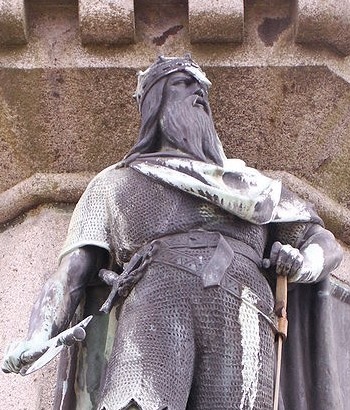
Rollo, also known with his epithet, Rollo "the Walker", was a Viking who, as Count of Rouen, became the first ruler of Normandy, a region in today's northern France. He was prominent among the Vikings who besieged Paris in 885-886, and he emerged as a war leader among the Norsemen who had secured a permanent foothold on Frankish soil in the valley of the lower Seine after the Siege of Chartres in 911. Charles the Simple, king of West Francia, agreed to the Treaty of Saint-Clair-sur-Epte, which granted Rollo lands between the river Epte and the sea in exchange for Rollo agreeing to end his brigandage, swear allegiance to Charles, convert to Christianity, and pledge to defend the Seine estuary from other Viking raiders.
Rollo's life was recorded by Dudo of St. Quentin. Historians such as W. Vogel, Alexander Bugge, and Henri Prentout have debated whether Dudo's account is historically accurate, and Rollo's origin and life are heavily disputed.
Rollo is first recorded in a charter of 918 as the leader of a group of Viking settlers, and he reigned over the region of Normandy until at least 928. He was succeeded as ruler of the new Duchy of Normandy by his son William Longsword. The offspring of Rollo and his followers, through their intermingling with the local Frankish and Gallo-Roman population, became known as the "Normans". After the Norman conquest of England and of southern Italy and Sicily over the following two centuries, their descendants came to rule England, much of Ireland, Sicily and Antioch from the 11th to 13th centuries, leaving behind an enduring legacy in the histories of Europe and the Near East.
The 10th-century French historian Dudo in his Historia Normannorum records that Rollo took the baptismal name Robert. A variant spelling, Rou, is used in the 12th-century Norman French verse chronicle Roman de Rou, which was compiled by Wace and commissioned by King Henry II of England, a descendant of Rollo.
The earliest well-attested historical event associated with Rollo is his part in leading the Vikings who besieged Paris in 885-886 but were fended off by Odo of France.
Sources do not make clear the year of Rollo's birth, but from his activity, marriage, children, and death, the mid-9th century may be inferred.
Among biographical remarks about Rollo written by the cleric Dudo of Saint-Quentin in the late 10th century, he claimed that Rollo "the Dane" was from Dacia, and had moved from there to the island of Scandza. Dacia originally referred to the region near the Black Sea, but Dudo identified it with Denmark by making a false etymology between Daci (Dacians) and Dani (Danes). One of Rollo's great-grandsons and a contemporary of Dudo was known as Robert the Dane. However, Dudo's Historia Normannorum (or Libri III de moribus et actis primorum Normanniae ducum) was commissioned by Rollo's grandson, Richard I of Normandy and while Dudo likely had access to family members and/or other people with a living memory of Rollo, this fact must be weighed against the text's potential biases, as an official biography.
According to Dudo, Rollo struck up a friendship in England with a king called "Alstem". This has puzzled many historians, but recently this person has been identified as Guthrum, the Danish leader whom Alfred the Great baptised with the name "Athelstan", and was recognised as King of the East Angles in 880.
Dudo recorded that when Rollo controlled Bayeux by force, he carried off the beautiful Popa or Poppa, a daughter of Berenger, Count of Rennes. He married her, and she bore his son and heir, William Longsword. Her parentage is uncertain, and may have been invented after the fact to legitimize her son's lineage, as many of the fantastic genealogical claims made by Dudo were. She may have come from any country with which the Norse had contact, as Dudo is a highly unreliable source who may have written his chronicle primarily as a didactic tool to teach courtly values.
There are few contemporary mentions of Rollo. In 911, Robert I of France, brother of Odo, again defeated another band of Viking warriors in Chartres with his well-trained horsemen. This victory paved the way for Rollo's baptism and settlement in Normandy. In return for formal recognition of the lands he possessed, Rollo agreed to be baptised and assisted the king in defending the realm. As was custom, Rollo took the baptismal name "Robert", after his godfather, Robert I.
The seal of the agreement was to be a marriage between Rollo and Gisela, daughter of Charles, possibly her legitimate father. Since Charles first married in 907, that would mean that Gisela was at most 5 years old at the time of the treaty of 911 which offered her in marriage. It has therefore been speculated that she could have been an illegitimate daughter. However, a diplomatic child betrothal need not be doubted.
The earliest record of Rollo is from 918, in a charter of Charles III to an abbey, which referred to an earlier grant to "the Normans of the Seine", namely "Rollo and his associates" for "the protection of the kingdom". Dudo retrospectively stated that this pact took place in 911 at Saint-Clair-sur-Epte.
Dudo narrates a humorous story not found in other primary sources about Rollo's pledge of fealty to Charles III as part of the Treaty of Saint-Clair-sur-Epte. The attendant bishops urged Rollo to kiss the king's foot to prove his allegiance. Rollo refused, saying "I will never bow my knees at the knees of any man, and no man's foot will I kiss." Instead, Rollo commanded one of his warriors to kiss the king's foot. The warrior complied by raising the king's foot to his mouth as the king was standing, which "caused the king to topple backward" much to the amusement of their entourage. On taking his oath of fealty, Rollo divided the lands between the rivers Epte and Risle among his chieftains and settled in the de facto capital of Rouen.
Given Rouen and its hinterland in return for the alliance with the Franks, it was agreed upon that it was in the interests of both Rollo himself and his Frankish allies to extend his authority over Viking settlers. This would appear to be the motive for later concessions to the Vikings of the Seine, which are mentioned in other records of the time. When Charles III was being deposed by Rudolph of France he appealed to Rollo and Ragenold [fr], another one of his Norman allies. With their combined army they marched to his aid in fulfilment of their pledge to the Carolingians, but were stopped at the Oise River by Charles' opponents who traded their cooperation for more territorial concessions. The need for an agreement was particularly urgent when Robert I, successor of Charles III, was killed in 923.
Rudolph was recorded as sponsoring a new agreement by which a group of Norsemen conceded the provinces of the Bessin and Maine. These settlers were presumed to be Rollo and his associates, moving their authority westward from the Seine valley. It is still unclear as to whether Rollo was being given lordship over the Vikings already settled in the region to domesticate and restrain them, or the Franks around Bayeux to protect them from other Viking leaders settled in eastern Brittany and the Cotentin peninsula.
Rollo died sometime between a final mention of him by Flodoard in 928, and 933 - the year in which a third grant of land, usually identified as being the Cotentin and Avranchin areas, was given to his son and successor William.
Rollo was the great-great-great-grandfather of William the Conqueror, the progenitor of House of Normandy in England. As such, Charles III and the current British royal family are descendants of Rollo, albeit not in the direct male line. Henry I of England was the last monarch of the House of Normandy; but his daughter Empress Matilda was ancestral to the English House of Plantagenet and subsequent English monarchs.
A genetic investigation into the remains of Rollo's grandson Richard the Fearless, and his great-grandson Richard the Good, was announced in 2011 to discern the origins of the historic Viking leader. On 29 February 2016, Norwegian researchers opened Richard the Good's tomb and found a lower jaw with eight teeth in it. However, the skeletal remains in both graves turned out to significantly predate Rollo and therefore are not related to him.
Rollo left a legacy as the founder of Normandy, and his leadership and integration of Viking settlers into the region transformed it into a stable political entity. His lineage played a key role in shaping medieval Europe, as it was William the Conqueror, another descendant of Rollo, who famously led the Norman Conquest of England in 1066. Rollo's baptism also marked a significant point in the assimilation of Viking settlers into Frankish society.
Rollo, also known with his epithet, Rollo "the Walker", was a Viking who, as Count of Rouen, became the first ruler of Normandy, a region in today's northern France. He was prominent among the Vikings who besieged Paris in 885-886, and he emerged as a war leader among the Norsemen who had secured a permanent foothold on Frankish soil in the valley of the lower Seine after the Siege of Chartres in 911. Charles the Simple, king of West Francia, agreed to the Treaty of Saint-Clair-sur-Epte, which granted Rollo lands between the river Epte and the sea in exchange for Rollo agreeing to end his brigandage, swear allegiance to Charles, convert to Christianity, and pledge to defend the Seine estuary from other Viking raiders.
Rollo's life was recorded by Dudo of St. Quentin. Historians such as W. Vogel, Alexander Bugge, and Henri Prentout have debated whether Dudo's account is historically accurate, and Rollo's origin and life are heavily disputed.
Rollo is first recorded in a charter of 918 as the leader of a group of Viking settlers, and he reigned over the region of Normandy until at least 928. He was succeeded as ruler of the new Duchy of Normandy by his son William Longsword. The offspring of Rollo and his followers, through their intermingling with the local Frankish and Gallo-Roman population, became known as the "Normans". After the Norman conquest of England and of southern Italy and Sicily over the following two centuries, their descendants came to rule England, much of Ireland, Sicily and Antioch from the 11th to 13th centuries, leaving behind an enduring legacy in the histories of Europe and the Near East.
Name
The Heimskringla (written in the 13th century) records that Rolf the Ganger went to Normandy and ruled it, so Rollo is generally presumed to be a Latinisation of the Old Norse name Hrólfr, a theory that is supported by the rendition of Hrólfr as Roluo in the Gesta Danorum by Saxo Grammaticus. It is also sometimes suggested that Rollo may be a Latinised version of another Norse name, Hrollaugr.The 10th-century French historian Dudo in his Historia Normannorum records that Rollo took the baptismal name Robert. A variant spelling, Rou, is used in the 12th-century Norman French verse chronicle Roman de Rou, which was compiled by Wace and commissioned by King Henry II of England, a descendant of Rollo.
Origins and historiography
Rollo was born in the mid-9th century, as his tomb states he was in his eighties when he died in 933; he was almost certainly born in Scandinavia, either in Denmark or Norway. In part, this uncertainty may result from the unspecific contemporary usage of terms such as "Vikings", "Northmen", "Norse", "Swedes", "Danes", and "Norwegians" (Dani vel Nortmanni in medieval Latin).The earliest well-attested historical event associated with Rollo is his part in leading the Vikings who besieged Paris in 885-886 but were fended off by Odo of France.
Sources do not make clear the year of Rollo's birth, but from his activity, marriage, children, and death, the mid-9th century may be inferred.
Among biographical remarks about Rollo written by the cleric Dudo of Saint-Quentin in the late 10th century, he claimed that Rollo "the Dane" was from Dacia, and had moved from there to the island of Scandza. Dacia originally referred to the region near the Black Sea, but Dudo identified it with Denmark by making a false etymology between Daci (Dacians) and Dani (Danes). One of Rollo's great-grandsons and a contemporary of Dudo was known as Robert the Dane. However, Dudo's Historia Normannorum (or Libri III de moribus et actis primorum Normanniae ducum) was commissioned by Rollo's grandson, Richard I of Normandy and while Dudo likely had access to family members and/or other people with a living memory of Rollo, this fact must be weighed against the text's potential biases, as an official biography.
Biography
Dudo's chronicle about Rollo seizing Rouen in 876 is supported by the contemporary chronicler Flodoard, who records that Robert of the Breton March waged a campaign against the Vikings, nearly levelling Rouen and other settlements. Eventually, he conceded "certain coastal provinces" to them. Although, scholars have debated this and have said that Rollo did not even arrive in West Francia until after the year 876, making this timeline given in Dudo wrong.According to Dudo, Rollo struck up a friendship in England with a king called "Alstem". This has puzzled many historians, but recently this person has been identified as Guthrum, the Danish leader whom Alfred the Great baptised with the name "Athelstan", and was recognised as King of the East Angles in 880.
Dudo recorded that when Rollo controlled Bayeux by force, he carried off the beautiful Popa or Poppa, a daughter of Berenger, Count of Rennes. He married her, and she bore his son and heir, William Longsword. Her parentage is uncertain, and may have been invented after the fact to legitimize her son's lineage, as many of the fantastic genealogical claims made by Dudo were. She may have come from any country with which the Norse had contact, as Dudo is a highly unreliable source who may have written his chronicle primarily as a didactic tool to teach courtly values.
There are few contemporary mentions of Rollo. In 911, Robert I of France, brother of Odo, again defeated another band of Viking warriors in Chartres with his well-trained horsemen. This victory paved the way for Rollo's baptism and settlement in Normandy. In return for formal recognition of the lands he possessed, Rollo agreed to be baptised and assisted the king in defending the realm. As was custom, Rollo took the baptismal name "Robert", after his godfather, Robert I.
The seal of the agreement was to be a marriage between Rollo and Gisela, daughter of Charles, possibly her legitimate father. Since Charles first married in 907, that would mean that Gisela was at most 5 years old at the time of the treaty of 911 which offered her in marriage. It has therefore been speculated that she could have been an illegitimate daughter. However, a diplomatic child betrothal need not be doubted.
The earliest record of Rollo is from 918, in a charter of Charles III to an abbey, which referred to an earlier grant to "the Normans of the Seine", namely "Rollo and his associates" for "the protection of the kingdom". Dudo retrospectively stated that this pact took place in 911 at Saint-Clair-sur-Epte.
Dudo narrates a humorous story not found in other primary sources about Rollo's pledge of fealty to Charles III as part of the Treaty of Saint-Clair-sur-Epte. The attendant bishops urged Rollo to kiss the king's foot to prove his allegiance. Rollo refused, saying "I will never bow my knees at the knees of any man, and no man's foot will I kiss." Instead, Rollo commanded one of his warriors to kiss the king's foot. The warrior complied by raising the king's foot to his mouth as the king was standing, which "caused the king to topple backward" much to the amusement of their entourage. On taking his oath of fealty, Rollo divided the lands between the rivers Epte and Risle among his chieftains and settled in the de facto capital of Rouen.
Given Rouen and its hinterland in return for the alliance with the Franks, it was agreed upon that it was in the interests of both Rollo himself and his Frankish allies to extend his authority over Viking settlers. This would appear to be the motive for later concessions to the Vikings of the Seine, which are mentioned in other records of the time. When Charles III was being deposed by Rudolph of France he appealed to Rollo and Ragenold [fr], another one of his Norman allies. With their combined army they marched to his aid in fulfilment of their pledge to the Carolingians, but were stopped at the Oise River by Charles' opponents who traded their cooperation for more territorial concessions. The need for an agreement was particularly urgent when Robert I, successor of Charles III, was killed in 923.
Rudolph was recorded as sponsoring a new agreement by which a group of Norsemen conceded the provinces of the Bessin and Maine. These settlers were presumed to be Rollo and his associates, moving their authority westward from the Seine valley. It is still unclear as to whether Rollo was being given lordship over the Vikings already settled in the region to domesticate and restrain them, or the Franks around Bayeux to protect them from other Viking leaders settled in eastern Brittany and the Cotentin peninsula.
Rollo died sometime between a final mention of him by Flodoard in 928, and 933 - the year in which a third grant of land, usually identified as being the Cotentin and Avranchin areas, was given to his son and successor William.
Rollo's Role in Norman Conversion to Christianity
Rollo's role in Christianity has been long debated by scholars. In his 1752 work Micromégas, Voltaire wrote that "peaceful Rollo was the only legislator of his time on the Christian continent". Recently, Scholars have said that Rollo's law-making was the cause of the civilization of Normandy, not his actual conversion to Christianity. While it has been supported that Rollo and his companions did get baptized, it has been argued that this conversion was only formal at first and paganism was still practiced.Descendants
Rollo's son and heir, William Longsword, and grandchild, Richard the Fearless, forged the Duchy of Normandy into West Francia's most cohesive and formidable principality. The descendants of Rollo and his men assimilated with the Frankish culture and became known as the Normans, lending their name to the region of Normandy.Rollo was the great-great-great-grandfather of William the Conqueror, the progenitor of House of Normandy in England. As such, Charles III and the current British royal family are descendants of Rollo, albeit not in the direct male line. Henry I of England was the last monarch of the House of Normandy; but his daughter Empress Matilda was ancestral to the English House of Plantagenet and subsequent English monarchs.
A genetic investigation into the remains of Rollo's grandson Richard the Fearless, and his great-grandson Richard the Good, was announced in 2011 to discern the origins of the historic Viking leader. On 29 February 2016, Norwegian researchers opened Richard the Good's tomb and found a lower jaw with eight teeth in it. However, the skeletal remains in both graves turned out to significantly predate Rollo and therefore are not related to him.
Legacy
Rollo's dynasty survived through a combination of ruthless military action and infighting among the 10th-century Frankish aristocracy, which left them severely weakened and unable to resist the Rouen Vikings' growing determination to stay put. After Rollo's death, his direct male descendants continued to rule Normandy until Stephen of Blois became King of England and Duke of Normandy in 1135. The duchy was later absorbed into what became the Angevin Empire following its conquest by Geoffrey of Anjou, who in 1128 had married Matilda of England, herself a descendant of Rollo.Rollo left a legacy as the founder of Normandy, and his leadership and integration of Viking settlers into the region transformed it into a stable political entity. His lineage played a key role in shaping medieval Europe, as it was William the Conqueror, another descendant of Rollo, who famously led the Norman Conquest of England in 1066. Rollo's baptism also marked a significant point in the assimilation of Viking settlers into Frankish society.
Parents
Father: Ragnvald EYSTEINSSON #49465
Mother: Ragnhild HRΌLFSDΌTTIR #49467
Family 1 :

                                                  _Ivar HALFDANSSON ___+
                                                 | (0780 - 0824)
                            _Eystein IVARSSON ___|
                           | (0810 - 0870)       |
                           |                     |_____________________
                           |
 _Ragnvald EYSTEINSSON ____|
| (0825 - 0894)            |
|                          |                      _____________________
|                          |                     |
|                          |_____________________|
|                                                |
|                                                |_____________________
|
|
|--Rollo RAGNVALDSSON
|  (0860 - 0932)
|                                                 _____________________
|                                                |
|                           _Hrolf NEFJA ________|
|                          |                     |
|                          |                     |_____________________
|                          |
|_Ragnhild HRΌLFSDΌTTIR _|
                           |
                           |                      _____________________
                           |                     |
                           |_____________________|
                                                 |
                                                 |_____________________