A Family Genealogy of
the Gentle House of Stapleton
the Gentle House of Stapleton
HomeFamily ListDatabaseSurname IndexIndex of IndividualsIndex of Noble HousesFamous and Infamous People
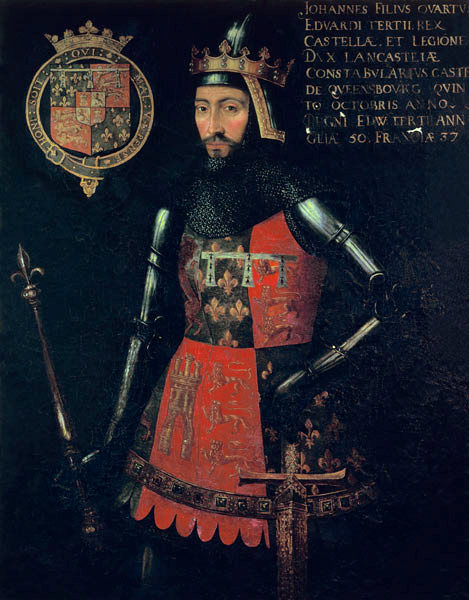
(Duke of Lancaster) John of Gaunt PLANTAGENET #58480
6 MAR 1339/40 - 3 FEB 1398/99
Personal Information
- TITLE: Duke of Lancaster
- BIRTH: 6 MAR 1339/40, Gent, Oost-Vlaanderen, Belgium
- DEATH: 3 FEB 1398/99, Leicester, Leicestershire, England
Notes
Founder of the Second House of Lancaster.
John of Gaunt, Duke of Lancaster, was an English prince, military leader and statesman. He was the fourth son (third surviving) of King Edward III, and the father of King Henry IV. Because of Gaunt's royal origin, advantageous marriages and some generous land grants, he was one of the richest men of his era and an influential figure during the reigns of both his father and his nephew, Richard II. As Duke of Lancaster, he is the founder of the royal House of Lancaster, whose members would ascend the throne after his death. His birthplace, Ghent in Flanders, then known in English as Gaunt, was the origin of his name.
John's early career was spent in France and Spain fighting in the Hundred Years' War. He made an abortive attempt to enforce a claim to the Crown of Castile that came through his second wife, Constance of Castile, and for a time styled himself as King of Castile. When Edward the Black Prince, Gaunt's elder brother and heir-apparent to the ageing Edward III, became incapacitated owing to poor health, Gaunt assumed control of many government functions and rose to become one of the most powerful political figures in England. He was faced with military difficulties abroad and political divisions at home, and disagreements as to how to deal with these crises led to tensions between Gaunt, the English Parliament and the ruling class, making him an unpopular figure for a time. He helped forge the 1386 Anglo-Portuguese alliance, secured through the marriage of his daughter Philippa to John I of Portugal, which endured for centuries.
John exercised great influence over the English throne during the minority of King Richard II (Edward the Black Prince's son) and the ensuing periods of political strife. He mediated between the king and a group of rebellious nobles, which included Gaunt's own son and heir-apparent, Henry Bolingbroke. Following Gaunt's death in 1399, the Lancastrian estates and titles were declared forfeit to the Crown, and the now disinherited son, Bolingbroke, was branded a traitor and ordered into exile. Henry did not stay in exile; he raised an army to reclaim his inheritance and depose Richard. He reigned as King Henry IV (1399-1413), the first of the descendants of John of Gaunt to hold the English throne.
John cultivated an extensive network of retainers, known as the Lancastrian affinity, which became the cornerstone of his political power and was later inherited by his eldest surviving son, Henry, the future King Henry IV. All English monarchs from Henry IV onwards are descended from John of Gaunt. His direct male line, the House of Lancaster, ruled England from 1399 until the Wars of the Roses. Gaunt is also generally believed to have fathered five children outside marriage: one early in life by a lady-in-waiting to his mother; the others, surnamed Beaufort, by Katherine Swynford, his long-term mistress and third wife. They were later legitimised by royal and papal decrees, but this did not affect Henry IV's bar to their having a place in the line of succession. Through his daughter Joan Beaufort, Countess of Westmorland, he was an ancestor of the Yorkist kings Edward IV, Edward V and Richard III. Through his great-granddaughter Lady Margaret Beaufort he was also an ancestor of Henry VII, who married Edward IV's daughter Elizabeth of York, and all subsequent monarchs are descendants of their marriage. Two of John's daughters married into continental royal houses (those of Portugal and Castile). Through them, many royal families of Europe can trace lineage to him.
He was buried beside his first wife, Blanche of Lancaster, in the choir of St Paul's Cathedral, adjacent to the high altar. Their magnificent tomb had been designed and executed between 1374 and 1380 by Henry Yevele with the assistance of Thomas Wrek, at a total cost of £592. The two alabaster effigies were notable for having their right hands joined. An adjacent chantry chapel was added between 1399 and 1403. During the reformation when other stonework in the cathedral was taken down in 1552, the tomb was spared by a command of the council, but was stripped plain. During the period of the Interregnum (1649-1660) it was severely damaged, and perhaps destroyed; anything that survived was lost (with the rest of the cathedral) in the Great Fire of London of 1666. A wall memorial in the crypt of the present cathedral lists Gaunt's as among the important lost monuments.
Their son Henry Bolingbroke became Henry IV of England, having deposed King Richard II, who had seized the duchy of Lancaster upon John's death while Henry was in exile. Their daughter Philippa of Lancaster became Queen of Portugal by marrying King John I of Portugal in 1387. All subsequent kings of Portugal beginning from the House of Aviz were thus descended from John of Gaunt. Philippa's daughter Isabella, married Philip the Good, Duke of Burgundy. Their lone heiress, Mary, the only child of Philip's only legitimate son Charles the Bold, married her 2nd cousin, Holy Roman Emperor Maximilian I, whose mother Eleanor, was the daughter of Philippa's son Edward. Their grandson Charles married Isabella, daughter of Manuel I of Portugal, a male line grandson of Edward.
On 13 January 1396, two years after the death of Constance of Castile, Katherine and John of Gaunt married in Lincoln Cathedral. Their children were given the surname "Beaufort" after a former French possession of the duke. The Beaufort children, three sons and a daughter, were legitimised by royal and papal decrees after John and Katherine married. From the eldest son, John, descended a granddaughter, Lady Margaret Beaufort, whose son, later King Henry VII of England, would nevertheless claim the throne.
A later proviso to the legitimation of the Beaufort children was that they were specifically barred from inheriting the throne-the phrase excepta regali dignitate ("except royal status")-was inserted with dubious authority by their half-brother Henry IV. However, as historian and author Nathen Amin points out there was no parliamentary ratification of this scribbled in amendment. Further testing and analysis on these three words is required to determine when exactly they were added. There is every possibility they were added as a later proviso during the height of the Wars of the Roses as a means to discredit any heirs of Margaret Beaufort.
Hungerford in Berkshire has ancient links to the Duchy, the manor becoming part of John of Gaunt's estate in 1362 before James I passed ownership to two local men in 1612 (which subsequently became Town & Manor of Hungerford Charity). The links are visible today in the Town & Manor-owned John O'Gaunt Inn on Bridge Street, and John O'Gaunt School on Priory Road.
John of Gaunt, Duke of Lancaster, was an English prince, military leader and statesman. He was the fourth son (third surviving) of King Edward III, and the father of King Henry IV. Because of Gaunt's royal origin, advantageous marriages and some generous land grants, he was one of the richest men of his era and an influential figure during the reigns of both his father and his nephew, Richard II. As Duke of Lancaster, he is the founder of the royal House of Lancaster, whose members would ascend the throne after his death. His birthplace, Ghent in Flanders, then known in English as Gaunt, was the origin of his name.
John's early career was spent in France and Spain fighting in the Hundred Years' War. He made an abortive attempt to enforce a claim to the Crown of Castile that came through his second wife, Constance of Castile, and for a time styled himself as King of Castile. When Edward the Black Prince, Gaunt's elder brother and heir-apparent to the ageing Edward III, became incapacitated owing to poor health, Gaunt assumed control of many government functions and rose to become one of the most powerful political figures in England. He was faced with military difficulties abroad and political divisions at home, and disagreements as to how to deal with these crises led to tensions between Gaunt, the English Parliament and the ruling class, making him an unpopular figure for a time. He helped forge the 1386 Anglo-Portuguese alliance, secured through the marriage of his daughter Philippa to John I of Portugal, which endured for centuries.
John exercised great influence over the English throne during the minority of King Richard II (Edward the Black Prince's son) and the ensuing periods of political strife. He mediated between the king and a group of rebellious nobles, which included Gaunt's own son and heir-apparent, Henry Bolingbroke. Following Gaunt's death in 1399, the Lancastrian estates and titles were declared forfeit to the Crown, and the now disinherited son, Bolingbroke, was branded a traitor and ordered into exile. Henry did not stay in exile; he raised an army to reclaim his inheritance and depose Richard. He reigned as King Henry IV (1399-1413), the first of the descendants of John of Gaunt to hold the English throne.
John cultivated an extensive network of retainers, known as the Lancastrian affinity, which became the cornerstone of his political power and was later inherited by his eldest surviving son, Henry, the future King Henry IV. All English monarchs from Henry IV onwards are descended from John of Gaunt. His direct male line, the House of Lancaster, ruled England from 1399 until the Wars of the Roses. Gaunt is also generally believed to have fathered five children outside marriage: one early in life by a lady-in-waiting to his mother; the others, surnamed Beaufort, by Katherine Swynford, his long-term mistress and third wife. They were later legitimised by royal and papal decrees, but this did not affect Henry IV's bar to their having a place in the line of succession. Through his daughter Joan Beaufort, Countess of Westmorland, he was an ancestor of the Yorkist kings Edward IV, Edward V and Richard III. Through his great-granddaughter Lady Margaret Beaufort he was also an ancestor of Henry VII, who married Edward IV's daughter Elizabeth of York, and all subsequent monarchs are descendants of their marriage. Two of John's daughters married into continental royal houses (those of Portugal and Castile). Through them, many royal families of Europe can trace lineage to him.
Death
John of Gaunt died of natural causes on 3 February 1399 at Leicester Castle, with his third wife Katherine by his side.He was buried beside his first wife, Blanche of Lancaster, in the choir of St Paul's Cathedral, adjacent to the high altar. Their magnificent tomb had been designed and executed between 1374 and 1380 by Henry Yevele with the assistance of Thomas Wrek, at a total cost of £592. The two alabaster effigies were notable for having their right hands joined. An adjacent chantry chapel was added between 1399 and 1403. During the reformation when other stonework in the cathedral was taken down in 1552, the tomb was spared by a command of the council, but was stripped plain. During the period of the Interregnum (1649-1660) it was severely damaged, and perhaps destroyed; anything that survived was lost (with the rest of the cathedral) in the Great Fire of London of 1666. A wall memorial in the crypt of the present cathedral lists Gaunt's as among the important lost monuments.
Family
Marriages
Blanche of Lancaster
On 19 May 1359 at Reading Abbey, John married his third cousin, Blanche of Lancaster, younger of the two daughters of Henry of Grosmont, Duke of Lancaster. Both shared a common descent as great-great-grandchildren from King Henry III. The wealth she brought to the marriage was the foundation of John's fortune. Blanche died on 12 September 1368 at Tutbury Castle, shortly after the birth of her last child while her husband was overseas. Of their seven children only three survived to adulthood.Their son Henry Bolingbroke became Henry IV of England, having deposed King Richard II, who had seized the duchy of Lancaster upon John's death while Henry was in exile. Their daughter Philippa of Lancaster became Queen of Portugal by marrying King John I of Portugal in 1387. All subsequent kings of Portugal beginning from the House of Aviz were thus descended from John of Gaunt. Philippa's daughter Isabella, married Philip the Good, Duke of Burgundy. Their lone heiress, Mary, the only child of Philip's only legitimate son Charles the Bold, married her 2nd cousin, Holy Roman Emperor Maximilian I, whose mother Eleanor, was the daughter of Philippa's son Edward. Their grandson Charles married Isabella, daughter of Manuel I of Portugal, a male line grandson of Edward.
Constance of Castile
In 1371, John married Infanta Constance of Castile, daughter of King Peter of Castile, thus giving him a claim to the Crown of Castile, which he would pursue. Constance died in 1394. Though John was never able to make good his claim, his daughter by Constance, Catherine of Lancaster, became Queen of Castile by marrying Henry III of Castile. Catherine of Aragon and Joanna of Castile were descended from Catherine through their mother Isabella I, daughter of Catherine's son John II. Isabella I was also a descendant of Catherine's half-sister Philippa, through her mother Isabella, who was the daughter of Philippa's other son John. Hence the House of Hapsburg is also related to John of Gaunt.Katherine Swynford
During his second marriage, some time around 1373 (the approximate birth year of their eldest son, John Beaufort) John of Gaunt entered into an extra-marital love affair with Katherine Swynford (born de Roet), the daughter of an ordinary knight (Sir Paon de Roet), which would produce four children for the couple. All of them were born out of wedlock, but were legitimised upon their parents' eventual marriage. The adulterous relationship endured until 1381, when it was ended out of political necessity. Prior to her widowhood, Katherine had had at least two children with her husband, Sir Hugh Swynford from Kettlethorpe in Lincolnshire. These were Blanche, for whom John of Gaunt stood as godfather, and Thomas, later Sir Thomas.On 13 January 1396, two years after the death of Constance of Castile, Katherine and John of Gaunt married in Lincoln Cathedral. Their children were given the surname "Beaufort" after a former French possession of the duke. The Beaufort children, three sons and a daughter, were legitimised by royal and papal decrees after John and Katherine married. From the eldest son, John, descended a granddaughter, Lady Margaret Beaufort, whose son, later King Henry VII of England, would nevertheless claim the throne.
A later proviso to the legitimation of the Beaufort children was that they were specifically barred from inheriting the throne-the phrase excepta regali dignitate ("except royal status")-was inserted with dubious authority by their half-brother Henry IV. However, as historian and author Nathen Amin points out there was no parliamentary ratification of this scribbled in amendment. Further testing and analysis on these three words is required to determine when exactly they were added. There is every possibility they were added as a later proviso during the height of the Wars of the Roses as a means to discredit any heirs of Margaret Beaufort.
Legacy
John of Gaunt is a character in William Shakespeare's play Richard II. Shortly before he dies, he makes a speech that includes the lines (in Act 2, scene i, around line 40) "This royal throne of kings, this scepter'd isle, This earth of majesty, this seat of Mars ... This blessed plot, this earth, this realm, this England". He is also referred to by Falstaff in Henry IV Part I (in Act 2, scene ii).Hungerford in Berkshire has ancient links to the Duchy, the manor becoming part of John of Gaunt's estate in 1362 before James I passed ownership to two local men in 1612 (which subsequently became Town & Manor of Hungerford Charity). The links are visible today in the Town & Manor-owned John O'Gaunt Inn on Bridge Street, and John O'Gaunt School on Priory Road.
Parents
Father: Edward III PLANTAGENET #58507
Mother: Philippa of AVESNES #58511
Family 1 :
Family 2 :
Family 3 :

                                                    _Edward I PLANTAGENET _____+
                                                   | (1239 - 1307)
                           _Edward II PLANTAGENET _|
                          | (1284 - 1327) m 1307   |
                          |                        |_Eleanor of IVREA _________+
                          |                          (1239 - 1290)
 _Edward III PLANTAGENET _|
| (1312 - 1377) m 1327    |
|                         |                         _Philip IV CAPET __________+
|                         |                        | (1268 - 1314)
|                         |_Isabella of CAPET _____|
|                           (1292 - 1358) m 1307   |
|                                                  |_Joan I of BLOIS __________+
|                                                    (1272 - 1305)
|
|--John of Gaunt PLANTAGENET
|  (1339 - 1398)
|                                                   _John II AVESNES __________+
|                                                  | (1247 - 1304)
|                          _William III AVESNES ___|
|                         | (1286 - 1337)          |
|                         |                        |_Philippa of LUXEMBOURG ___+
|                         |                          (1252 - 1311)
|_Philippa of AVESNES ____|
  (1311 - 1369) m 1327    |
                          |                         _Charles VALOIS ___________+
                          |                        | (1269 - 1325) m 1290
                          |_Joan of VALOIS ________|
                            (1294 - 1341)          |
                                                   |_Margaret of ANJOU-NAPLES _+
                                                     (1272 - 1299) m 1290