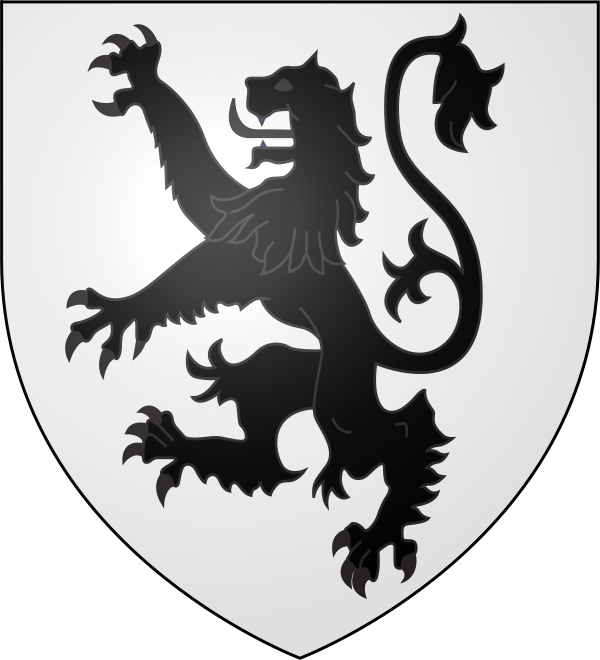
The Enduring Record
The House of Stapleton is among the most ancient families of England, its lineage extending across centuries of service, landholding, and historical record. Its presence is preserved not only in tradition, but in documents, estates, and enduring lineage.
Early Origins of the Stapleton Family
Like all families whose roots reach deep into the past, the true origin of the Stapleton family disappears into the shadows of history. There comes a point where names vanish, and only the movement of people remains.
The Stapleton name derives from the village of Stapleton-on-Tees, situated along the River Tees, a long-standing boundary between Yorkshire and Northumberland. The river provided trade, protection, and passage, making the settlement a natural crossing point from an early period.
Long before the Saxons, the land was held by the Brigantes, a Celtic tribe established by around 500 BC. Their capital at Aldborough—later known as Isurium Brigantum under Roman rule—became a significant administrative center following the Roman conquest in the 1st century AD.
After the Roman withdrawal, Britain entered a period of uncertainty. From the mid-5th century, Angles, Saxons, and Jutes settled across the land, forming competing kingdoms and establishing the cultural foundations of early England.
The arrival of Norse forces in the 9th century further reshaped the region. York became a center of Viking settlement, and the surrounding lands fell within the Danelaw, where Scandinavian customs and governance prevailed.
This period of transition came to an end with the Norman Conquest of 1066. In the Domesday survey of 1086, Stapleton-on-Tees appears under the holding of Benedict de Stapleton, marking the family’s first clear entry into the historical record.
From that point onward, the family aligned itself with the Crown. Across generations, members of the House of Stapleton served in military, political, and religious capacities, extending their presence into Ireland, continental Europe, and eventually the New World.
Migration to Ireland
In 1166, Dermot MacMurragh, King of Leinster, was driven from his throne and sought aid from King Henry II of England.
Richard FitzGilbert de Clare, known as Strongbow, accepted the alliance and led forces into Ireland in 1170. Among those who accompanied him was Sir John of Stapleton, representing the family’s early expansion beyond England.
Following the campaign, Sir John was granted extensive lands in Kilkenny and Tipperary. From this foundation, the Irish branch of the Stapleton family was established.
Migration to America
During periods of political and religious upheaval in England, many families sought new opportunities beyond their homeland.
The Stapleton family remained steadfast in the Catholic faith and were counted among the recusants—those who refused to conform to the Church of England following the Reformation. This position carried significant penalties, including fines, loss of property, and exclusion from public life.
In response to these pressures, some members of the family emigrated. Among them was Thomas William Stapleton, Sr. (1657–1706), who established the family’s presence in America.
Settling initially in western Virginia, the family later expanded into Kentucky, where subsequent generations continued to build upon the legacy of resilience and continuity that had defined the House for centuries.
Modern Era
The House remains defined by continuity and record, with its history preserved and presented through archival and genealogical documentation.
Record and Legacy
Across the centuries, the enduring presence of the House has been defined not by singular events, but by continuity. Its record is preserved in documents, land, and lineage—each reinforcing the stability of its place within history.
The purpose of this archive is not merely preservation, but clarity: to present an accurate account of the House and its place within the historical fabric of England.